Family life produces treasure at a staggering rate — the funny thing the four-year-old said at breakfast, the drawing taped to the fridge, the way the whole crew looked on the first day of school — and loses almost all of it, because memory is a sieve and phones are where photos go to be forgotten. Keepsake projects are how families fight back: small, repeatable rituals that catch the good stuff as it happens and turn it into objects you can hold. None of these require craft-store talent. They require a container, a habit, and the willingness to start before the moment passes.
The Family Memory Jar
The lowest-effort, highest-return keepsake in existence is a jar on the kitchen counter with a pad of paper and a pen beside it. When something happens worth keeping — a hilarious misquote, a small triumph, a disaster that will be funny later — anyone writes it on a slip, dates it, and drops it in. No ceremony, ten seconds, done.
The payoff comes once a year, when the family empties the jar and reads every slip aloud — a tradition that suits a new year, a solstice, or the last night of summer. Half the slips will have been completely forgotten by everyone, which is precisely the proof of the jar's value. Archive each year's slips in a labeled envelope, and within a few years you own a comedy and history collection no photo album can rival.
Record the Voices, Not Just the Faces
Photos are everywhere; voices are the thing families lose. Start a recording ritual: once or twice a year, capture each child telling a story, singing the song of the moment, or answering the same short interview — favorite food, best friend, what you want to be, tell me a joke. Keep each clip short and label it with name and age immediately, because unlabeled audio is future confusion.
Extend the project upward through the generations. Record grandparents telling the family's origin stories: how they met, the first house, the legendary mishaps. Kids make excellent interviewers, and elders open up differently for a grandchild with serious questions. Back these files up in two places; they appreciate faster than anything else in the family archive, and someday a recording of grandma laughing will be beyond price.
Handprints, Heights, and the Growing Body Archive
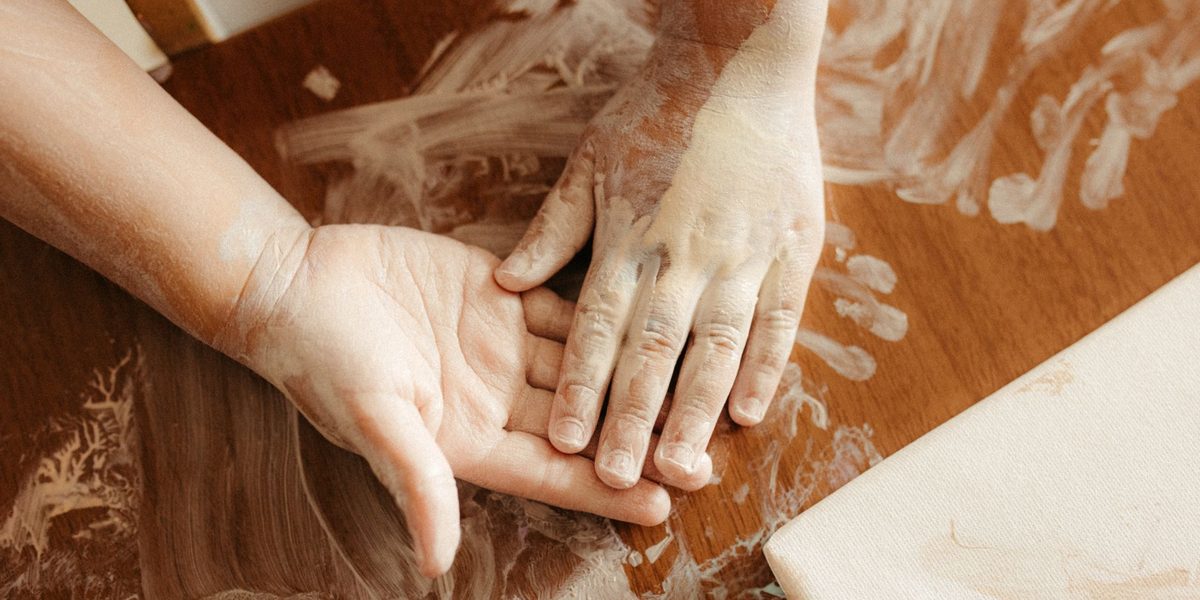
Children grow at a rate that is impossible to perceive and devastating to review, which is why body-scale keepsakes hit so hard. The classics endure because they work: an annual handprint in paint on a single large canvas, each print labeled with age, slowly building a flock of hands across a decade; a measuring wall on a doorframe — or better, on a removable board that can move house with you — marked ceremonially on each birthday.
Add variations as kids grow: a traced outline of the whole child on kraft paper at ages three, six, and nine; a yearly photo holding the same stuffed animal, which shrinks magically over time; the first-day-of-school shot on the same porch step every September. The power is in the repetition — any single entry is cute, but the series is a time machine.
Turn Kid Art into Curated Collections
Children's artwork arrives in volumes no refrigerator can hold, and guilt-driven hoarding serves nobody. The keepsake move is curation: each child selects their own top pieces at intervals — end of each season works well — and those winners enter the permanent collection, a labeled portfolio box or binder per kid. Photograph the rest before recycling, and the digital gallery preserves everything while the physical archive stays treasured rather than overwhelming — the artist, notably, is usually far less sentimental about the surplus than the parents are.
Elevate the best of the best: frame one piece per child per year for a rotating hallway gallery with little museum labels — artist, age, title as dictated by the artist, which is where the real comedy lives. Some families turn a favorite drawing into the design for the year's holiday card or have a child's monster doodle sewn into a stuffed toy. Being exhibited teaches kids their work matters; the labels teach parents what the drawing actually depicted.
The Family Recipe and Tradition Archive
Some of the most precious family artifacts live in kitchens and habits, unwritten. Start the archive now: collect the recipes the family actually makes — the birthday cake, the soup for sick days, grandpa's pancakes — written by hand where possible, stains welcome, with notes on who taught it and when it gets made. Photograph elder relatives' original recipe cards even if you also transcribe them; the handwriting is half the heirloom.
Document the traditions themselves alongside the food: how your family does birthday mornings, the exact rules of the beach-day ritual, the words everyone says before the holiday meal. Written plainly in a single book, this becomes the family's operating manual — the thing a grown child will consult decades from now when trying to recreate the soup and the feeling in a kitchen of their own.
Projects That Take a Year on Purpose
Some keepsakes gain their meaning from duration. A few worth committing to:
- The one-line-a-day journal: a single sentence about the day, written at bedtime; five minutes a week, a family novel in five years.
- The monthly porch photo: same spot, same arrangement, twelve frames a year; the flip-through is astonishing.
- The t-shirt quilt pipeline: outgrown shirts from teams, camps, and phases saved in a bin until there are enough for a quilt — sewn at home or sent out — that becomes the most fought-over blanket in the house.
- The birthday letter: a short annual note from parent to child, sealed and saved for a milestone birthday hand-off.
- The year jar countdown: a photo printed each month and added to a frame or album on the last day of the year.
Pick one, not five. A single sustained project beats a drawer of abandoned ambitious ones, and every project on this list survives on ten minutes a month.
Store It So It Survives
A keepsake that molders in a damp basement was a memory with a delay on its loss. Give the family archive a real home: one dry, indoor shelf or trunk, with a box per child plus a household box, labeled plainly. Paper wants stable temperatures; photos want to be printed, because screens fail and formats age but a shoebox of prints has never once required a software update. Digital treasures — the voice recordings, the art gallery — live in two places, one of them away from the house.
Schedule one archive hour a year, perhaps the same night the memory jar gets read: file the year's additions, label the unlabeled, and let everyone paw through the old boxes. The pawing is not a threat to the archive. The pawing is the entire point of having one.
Final Thoughts
Preserving family memories is not a scrapbooking talent; it is a set of small habits with containers attached. Put the jar on the counter this week, record one voice, mark one height, and choose a single year-long project to start. The moments are already happening — the jokes, the growth spurts, the recipes made from memory. All these projects do is catch what your family already is, and hold it somewhere safe until the day everyone wants desperately to see it again.