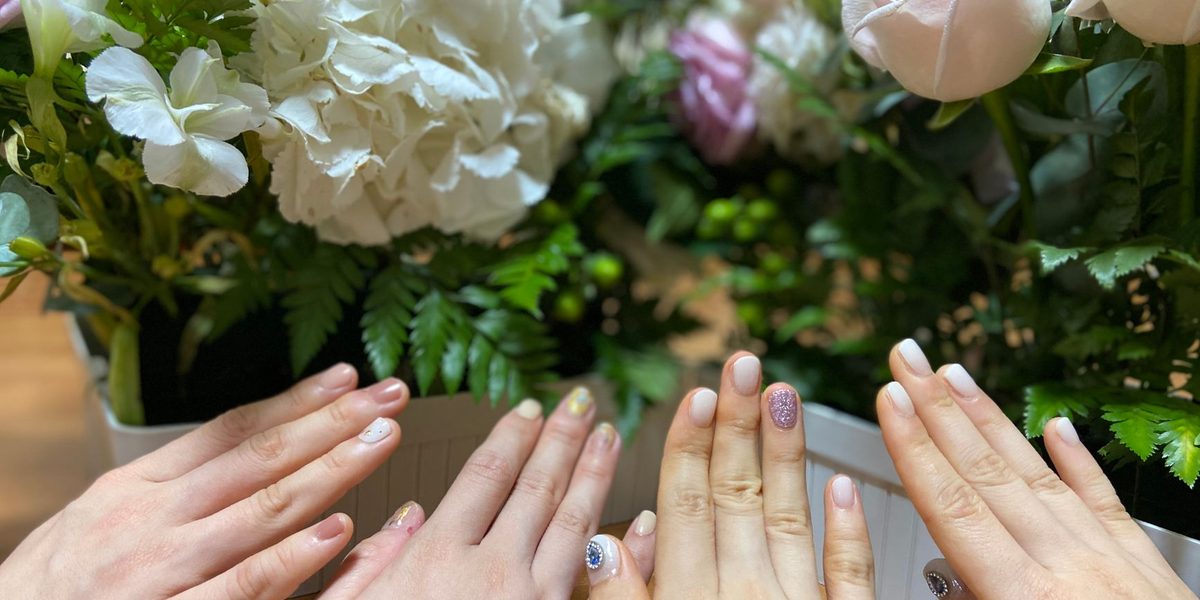
Nature is the most generous design department there is, and it publishes a new collection every season: petal pinks in spring, sea glass in summer, amber and rust when the leaves turn, frost and evergreen in the cold. Borrowing those palettes and motifs for your nails is the easiest way to make home manicures feel fresh all year — you never run out of ideas, because the window keeps supplying them. The designs below are organized as a year-round tour, and every one of them is achievable with basic polish, a bobby pin for dotting, and a toothpick for the finer moments. Perfection isn’t the aesthetic; nature itself is pleasantly irregular, which makes this the most forgiving genre in nail art.
Spring: Petals, Buds, and Rain
Spring nails are built from the five-dot flower, the friendliest design in existence: five dots of one color arranged in a circle with a contrasting dot in the center, placed near a nail’s edge like a corsage. Cluster two or three blossoms on an accent nail over a sheer milky base, and leave the rest of the nails plain — restraint is what makes the set look styled rather than crafted, and it keeps the whole manicure under fifteen minutes.
Beyond blossoms: tiny leaf pairs flicked beside each flower with a toothpick dipped in green; a “lily of the valley” idea with little white bell-dots descending a curved stem; scattered mixed-size dots in pastel tones as falling petals; and the rain take — diagonal short dashes of pale blue over a cloud-grey base. Spring’s palette does half the work: blush pink, butter yellow, new-leaf green, and lilac over milky or bare bases read as the season even in solid coats with no art at all.
Summer: Ocean, Citrus, and Golden Hour
Summer’s signature move is the water gradient: sponge two or three blues from a deeper tone at the tip to pale aqua near the base using a torn makeup sponge, then seal with glossy top coat so it reads as sea. Add a single white curve of “foam” along the tip line with a fine brush, or keep it abstract. Sea glass is the softer cousin — irregular patches of frosted mint, aqua, and sand tones over a nude base, finished matte.
For the fruit-stand mood, a citrus-slice accent nail (a half-circle of yellow or orange at the tip, segmented with thin white lines) is pure sunshine, and much easier than it looks since the lines can wobble like real fruit. Golden-hour nails skip motifs entirely: peachy-coral base with a gold shimmer coat gradient-heavy at the tips, like light on the horizon. Summer forgives brightness that other seasons question — this is the window for the loud coral and the unapologetic turquoise. Toes join the program in summer, too: a matching or deliberately mismatched pedicure in the same palette finishes the seasonal set, and since toenails are smaller canvases, a single dot-flower or plain bold coat is all they need.
Autumn: Leaves, Harvest, and Sweater Weather
Autumn owns the richest palette of the year — rust, ochre, olive, burgundy, chocolate — and honestly, a tonal set of those five shades across five nails is already a complete nature design. For motifs, the simple leaf is a two-stroke move: two curved toothpick strokes meeting at a point, in amber over cream, scattered like a breeze went by. A branch idea — one thin brown line up the nail with alternating leaf-dots — makes an elegant accent nail.
Texture experiments suit the season: a plaid accent (two thin vertical lines crossing two horizontal, in cream and rust over caramel) reads as flannel; matte top coat over any autumn shade instantly says sweater weather; and the tortoiseshell idea — irregular blobs of amber and brown over a warm sheer base, blurred slightly before top coat — is the season’s most sophisticated trick, and genuinely easier than stripes since irregularity is the goal.
Winter: Frost, Evergreen, and Starlight
Winter designs split into two moods. The frosty register: white dots in varying sizes scattered like snowfall over icy blue or deep navy; a single hand-drawn snowflake (three crossing thin lines with tiny dots at the ends — far simpler than real snowflake geometry) on an accent nail; or a “frosted window” of sheer white sponged just at the tips. The cozy register: forest green with a thin gold ring stripe, deep berry with one pearl-white accent nail, or tiny evergreen trees — three stacked toothpick triangles — marching across one nail.
Starlight is the crossover idea that carries from deep winter into the new year: a near-black navy base with irregular gold or silver micro-dots, denser toward one corner, like a clear cold sky. It photographs beautifully, hides chips well, and takes five minutes flat. Winter is also the season to be kindest to the nails themselves — cold air and indoor heating make them brittle — so let every frosty design sit over a nourishing base coat, and keep cuticle oil beside the polish as part of the ritual.
Techniques That Cover the Whole Year
Four humble tools produce every design above:
- The bobby-pin dotter: flowers, snowfall, berries, stars — dots are half of nature art. Barely load it, and redip often.
- The toothpick liner: stems, branches, leaf strokes, and snowflake arms. Drag quickly and lightly; spindly is correct for nature, which never draws a perfectly even line either.
- The torn sponge: gradients for sea, sky, sunset, and frost. Dab, don’t drag, and a glossy top coat melts the sponge speckle into perfect smoothness.
- The tape edge: horizon lines, tips, and color blocks. Press on a dried base, paint against it, peel while wet.
The universal finisher is glossy top coat for water and petals, matte for leaves, wool, and frost — finish alone can move a design from one season to another. And the accent-nail principle applies year-round: one or two decorated nails over a coordinated solid set always reads more polished than ten busy canvases.
Bring the Outside In: Finding Your Own Motifs
The deepest well of ideas isn’t a screen — it’s the walk you already take. A photo of moss on a wall is a green-on-green palette. A shell from a beach trip is a nude-and-blush gradient with a pearl accent. The exact orange of the maple on your street is next week’s base coat. Keep a little album of these captures and pull from it on manicure night; matching a design to a real thing you actually saw gives every set a story, and stories are exactly what make people stop and ask about your nails.
This is also the most personal way to keep the hobby fresh: your seasons look different from anyone else’s, whether that’s desert blooms, city park chestnuts, or the particular grey of your coastline. Nature-inspired doesn’t mean generic-botanical — it means observed. The manicure becomes a tiny travel journal, one week at a time.
Final Thoughts
Painting the seasons onto your nails is a small, renewable pleasure: four palettes, a handful of dot-and-stroke motifs, and a design calendar that refreshes itself outside your window. Start with wherever the year currently is — five-dot blossoms, a sponge-sea gradient, two-stroke leaves, or a scatter of snowfall — on a single accent nail this week. By the time you’ve painted through a full cycle, you’ll have a personal repertoire keyed to your own landscape, and the changing weather will feel less like something that happens to you and more like a design brief.